The Rusty Pick: Lastwick’s Unofficial Front Door

Before the ruins opened, it was a tavern. After the Awakening, it became the place every secret in Lastwick passed through first.

From the records of Archie Plume, Archivist
Every frontier town eventually builds the place it truly needs.
Not the place named in its charter. Not the watch house, the counting room, or the little shrine raised to whichever god the founders hoped might favor them. Those buildings tell you what a town wishes to become. If you want to know what it already is, you go where people gather after dark, when the day’s labor has loosened their tongues and left mud drying on their boots.
In Lastwick, you go to the Rusty Pick.
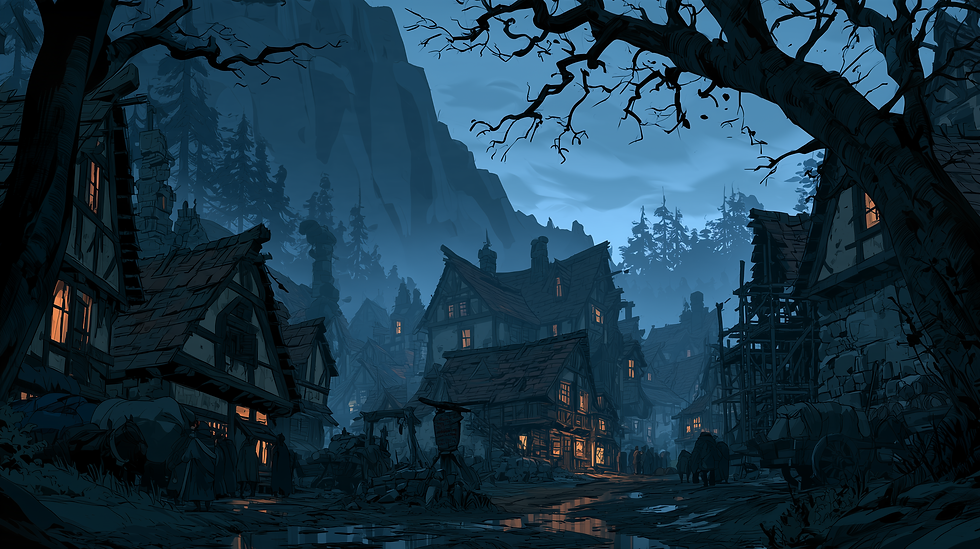
The tavern stands along the town’s old working road, close enough to the gate that a traveler can find it before learning the streets and far enough from the watch post that a private conversation may remain private. Its sign hangs from a blackened iron bracket above the door: a miner’s pick painted on a slab of rough timber, the iron head gone orange-brown with weather. Rainwater gathers at its lowest point and falls in slow, regular drops onto the stones below.
No one agrees on how old the place is.
The keeper claims the tavern predates Lastwick’s eastern wall. A surveyor once insisted that the foundation stones had been taken from something older still. Both stories may be true. In frontier country, buildings are rarely born whole. They are assembled from what survived the last fire, the last winter, or the last people foolish enough to believe the wilderness had finished with them.
Before the Awakening
Long before scholars began arriving with brass instruments and sealed letters, the Rusty Pick served miners, drovers, timber crews, caravan hands, and those who made their living guiding strangers through country they did not understand.
It was never elegant, even by Lastwick standards. The floorboards had already begun to bow near the bar. Smoke had darkened the ceiling beams until they shone like old iron. The shutters never closed squarely, and in hard weather the wind found the gaps no matter how much cloth was stuffed into them. But the hearth drew properly, the roof mostly held, and a person with coin could count on hot stew, small beer, and a place near the fire where nobody asked what road had brought them there.
That was enough.
Then the old places began waking.
Sealed chambers opened beneath hills that had stood undisturbed for centuries. Wards failed. Strange lights appeared between the trees. Farmers turned up worked stone in fields their families had plowed for generations. A shepherd might arrive in town carrying a coin no living kingdom had minted, and by morning three scholars, two treasure hunters, and a hired blade would be arguing over it at the same table.
Lastwick changed quickly. The Rusty Pick changed with it.
The Room
The first thing most travelers notice is the heat. The second is the noise.
The common room is broad but crowded, built around a stone hearth large enough to warm wet cloaks and cook the evening pot at once. Long tables occupy the center of the floor, their surfaces carved with initials, tally marks, crude maps, and at least one set of directions that has led several hopeful prospectors into a bog. Smaller tables press against the walls beneath candle sconces that burn low and smoke badly.
The room smells of damp wool, lamp oil, cheap ale, woodsmoke, and whatever has been simmering since midday. On busy nights another scent slips beneath them all: the sharp, metallic trace of raw magic carried in on tools, clothing, and things wrapped too carefully in cloth.
Behind the bar, shelves hold bottles from half a dozen territories alongside jars of pickled roots, lamp wicks, sealing wax, and several practical remedies whose ingredients are never discussed. A scarred wooden plaque lists the house rules. Most are simple:
Pay what you owe.
Keep steel sheathed unless you intend to answer for drawing it.
Do not interfere with the staff.
Do not touch another person’s find.
The last rule was added after the Awakening. It is also the one most strictly enforced.
No chair in the Rusty Pick truly matches another. No table sits entirely level. Near the back wall, however, there is a corner from which a careful patron can see the door, the bar, the stair, and most of the common room without appearing to watch any of them.
It is an excellent place for someone who dislikes surprises.
Kellan Marek found it almost immediately.
What Passes Through
By sunset, the Rusty Pick becomes a rough census of Lastwick.
Laborers arrive first, carrying the day on their shoulders. Caravan guards follow when the wagons are secured. Local traders take the tables nearest the bar, where they can be seen without surrendering their purses to the crush. Scholars gather in small defensive knots around their papers and pretend not to listen to anyone outside them. Mercenaries pretend not to watch the scholars.
There are settlers looking for work, guides looking for clients, thieves looking for both, and adventurers still new enough to the trade that they speak openly about what they hope to find. Some come to Lastwick with royal charters or university seals. Others possess only a shovel, an old map, and the dangerous conviction that fortune has been waiting specifically for them.
The Rusty Pick receives them all with the same measure of ale.
This apparent neutrality is one of the tavern’s most useful fictions. The keeper does not declare loyalties, but the room remembers behavior. A scholar who cheats a guide may discover that no one will lead her beyond the eastern ridge. A mercenary who abandons a companion may still be served, though every conversation will quiet when he approaches. A traveler who pays fairly, keeps confidence, and helps lift a wagon from the mud may return months later to find that his drink has been poured before he reaches the bar.
Lastwick possesses official records. The Rusty Pick keeps the more accurate kind.
The Market Beneath the Market
Nothing is formally sold inside the tavern except food, drink, beds, and occasionally the return of a misplaced purse. Nevertheless, more business passes through the Rusty Pick than through several of Lastwick’s licensed counting houses combined.
Maps change hands there. So do names.
A recovered artifact may never leave the satchel beneath its owner’s chair, yet by midnight half the room will know where it was found and the other half will be lying about what it is worth. Guides are hired over bowls of stew. Expeditions are assembled beside the hearth. Salvage rights are disputed, partnerships are formed, and warnings are offered in voices low enough that only the intended listener—and three neighboring tables—can hear them.
The wisest patrons understand that information in the Rusty Pick is neither free nor reliably priced. Some rumors cost a drink. Others cost a favor. The most dangerous are given away.
There is always someone eager to tell a newcomer which ruin is undefended, which road is safe, or which door has never been opened. The details improve with every telling. The bodies are rarely mentioned.
What the Pick Does Not Ask
For all its noise, the tavern survives by respecting certain silences.
No one asks too closely why a traveler wears gloves beside a hot fire. No one demands the name beneath a road alias unless payment depends upon it. Old scars are noticed but not inventoried. Those who wake from nightmares upstairs are judged only by how much furniture they break.
This restraint should not be mistaken for kindness. Lastwick is not a gentle town, and the Rusty Pick is not a sanctuary. It is something more practical: neutral ground maintained by common need. A person may sit alone without being lonely in peace, conduct business without surrendering every secret, and warm himself beside strangers who understand that survival sometimes requires the courtesy of looking away.
Kellan valued such courtesies. They allowed him to pass as merely another weathered traveler: quiet, armed, and uninterested in company. In a room crowded with stranger sights, pale skin and dark gloves invited notice but not yet alarm.
That distinction mattered.
The Night the Door Opened
Most nights at the Rusty Pick become indistinguishable with time. Cups empty. Dice turn. Wet cloaks steam beside the hearth. Someone exaggerates a journey, someone else doubts it, and the argument grows warmer than the fire.
But every tavern has a night after which its older stories feel like they belonged to another age.
At the Rusty Pick, it began in cold rain.
A wounded scholar came through the door carrying terror, a blood-soaked satchel, and something that should never have reached Lastwick. Conversation died around him. Chairs scraped back. Men who had spent months boasting of awakened ruins suddenly remembered caution.
In the corner, Kellan Marek lowered his drink and watched the room change.
Later accounts would disagree about nearly everything: who first stood, who first reached for a weapon, and whether the frost appeared before or after the satchel opened. They agree only upon the scholar’s warning.
They had woken something.
And for one suspended moment, every secret in the Rusty Pick listened.
The Rusty Pick first appears in Chapter One of The Frostbound Chronicles: A Piece of the Lock. Further records from Lastwick, the Awakening, and the people caught within it will appear in Lore.


Comments